
Hey!
Is your winning ad not scaling anymore?
Every winning ad follows a predictable cycle.
It starts strong, scales efficiently and then almost inevitably begins to decline.
Not because something broke, not because the algorithm changed overnight, and finally not because your offer suddenly became irrelevant.
But because the system it operates in has limits.
The platform prioritises delivering your ad to the highest probability users first.
And then continues revisiting them as it scales.
Therefore, the platform keeps on showing the same high intent users the same ad over and over again.
Leading to high frequency and decline in engagement.
So the ad is bound to decay.
Thus, the real problem lies within advertisers who don’t prepare for this.
Those who refuse to recognise the decline initially.
And finally when CPA is up by 45%, CTR is at 0.7% and the spend is no longer producing proportional returns,
They realise the damage is already done.
The Winning Ad Lifecycle Explained
In the post-Andromeda reality, most winning ads follow a very similar route.
In the first 3–5 days
This is the fresh phase.
- Performance is stable
- CTR is healthy
- CPM is controlled
- CPA is in range
- ROAS looks strong
At this stage, the ad is doing exactly what a winning ad should do.
It is fresh. It is relevant.
And it is reaching a newer audience.
Then for the next 10–20 days
This is the rosy phase.
This is usually when you increase spend.
And if the ad is genuinely strong, it will continue to perform really well.
That is not a problem.
That is the point.
The ad is scaling.
Results are coming in.
The dashboard looks good because the ad is actually doing good.
But after day 20
A few things start changing in the background.
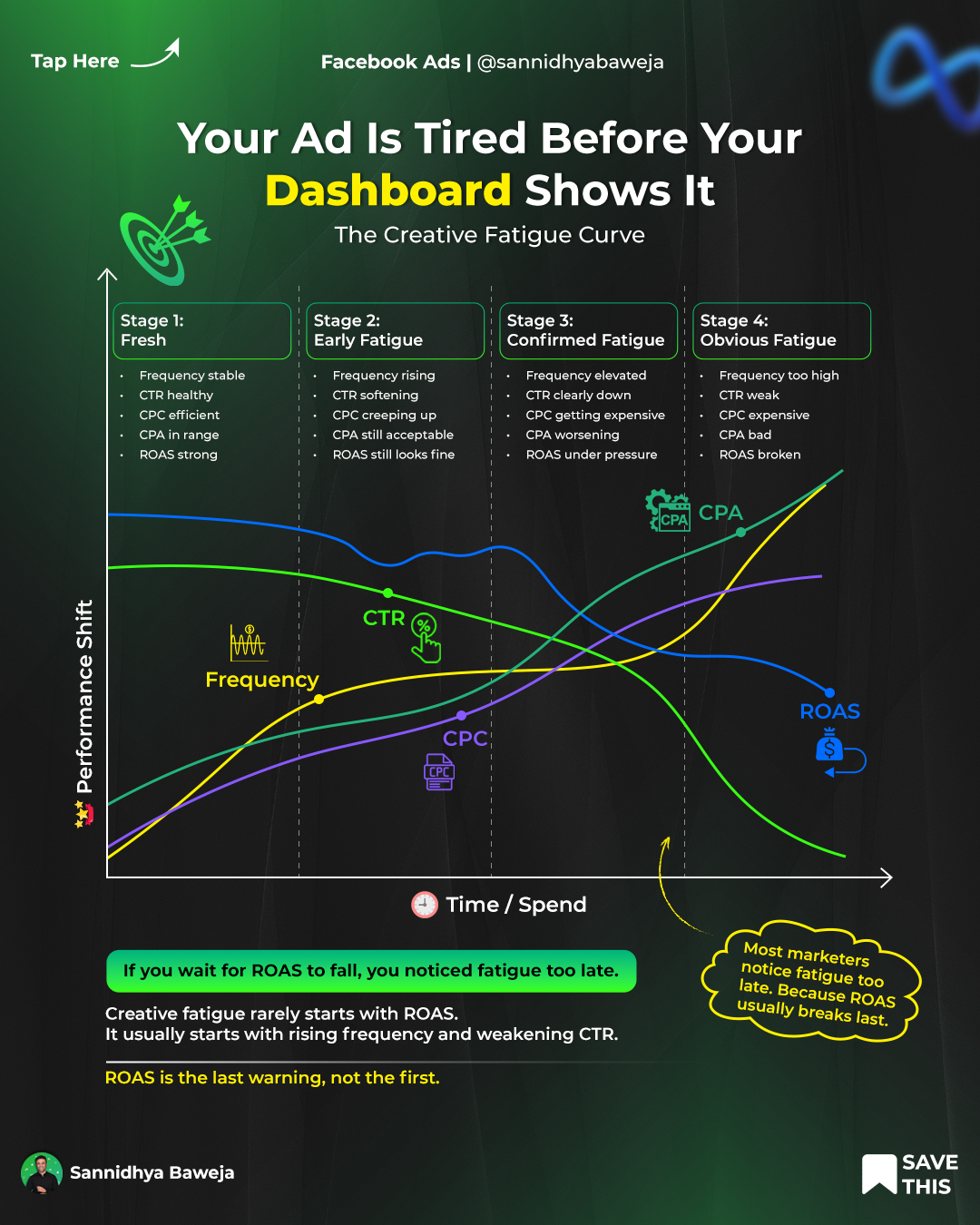
This is where fatigue starts building quietly.
- Frequency starts rising
- CTR starts softening
- CPC starts creeping up
- CPA starts getting worse
At this point, the ad may still look fine at a top level.
But underneath, efficiency is starting to shift.
Then by around day 21–27
The fatigue becomes visible.
Now the cracks start showing clearly.
- CTR is noticeably weaker
- Frequency is too high
- CPC is expensive
- CPA becomes unstable
- ROAS starts coming under pressure
This is the stage where people finally notice the ad is slowing down.
But the truth is:
The fatigue had already started before this.
Why does this happen?
Because once you increase spend, the platform has to generate more impressions inside the same targeting constraints.
That means the same audience starts seeing the ad more often.
Frequency rises faster.
Novelty drops faster.
And the ad reaches saturation faster.
So the ad does not suddenly stop working.
It follows a route.
It starts fresh.
It scales well.
It gives you a strong run.
Then fatigue starts in the background.
Then the metrics begin to crack.
And finally, the decline becomes visible.
And that is the lifecycle of a winning ad in the post-Andromeda environment.
The Customer Decision Cycle
To understand why this happens, it is important to look beyond metrics and into the user behaviour.
An average user follows a decision cycle.
- On the first few exposures, the ad is new so the curiosity is high.
- On the next few exposures, it is being processed consciously and the worth is deduced.
- On the final exposure, a decision is made.
However the cycle is not fixed.
It differs from industry to industry, product to product.
While also on product’s price and customer’s buying intent.
Lower AOV products typically require fewer touchpoints.
But higher AOV products have to go through more touchpoints before the final decision.
Here is a sheet based on tested touchpoint benchmarks across different AOV ranges. [https://docs.google.com/spreadsheets/d/1HAwKeAP2UJQOwxoNzMdrOMGU2KRkKR36pCiQjHuQtwY/edit?usp=sharing]
So when your frequency crosses 2.5 (for low to mid AOV products),
a large portion of your impressions are being served to the users who have already completed this cycle.
Therefore your ad is essentially being ignored.
This is the moment the metrics begin to reflect the behavioral fatigue.
So remember this is not your creative failure but a natural consequence to any ad.
The Structural Flaw
Therefore the core issue is not quality.
It is the single winning ad model.
Most advertisers operate with a single winning ad approach.
They find a winning ad, increase spend, and rely on it to sustain performance as long as possible.
This process looks like:
Winning ad → Budget increase → Performance drop → Urgent search for replacement
But this approach creates instability.
Because all of the pressure of carrying the whole brand’s performance is on one single asset.
Therefore, instead of depending on one winner.
Why not create a library of winners at different stages of readiness.
Expanding Instead of Protecting
A common reaction to finding a winning ad is to preserve it.
This is counterproductive.
A winning ad should be treated as a source of iteration and not a finished product.
One of the simplest ways to do so is by the 3-2-2 approach.
- 3 variations of the creative (different visuals, scenes or text placements)
- 2 variations of the hook (different angles or openings)
- 2 variations of the format (example, static vs video, polished vs UGC)
These will give you 12 variations of the same winner ad for you to launch in groups.
Now what makes this effective is that they will be distributed across various audiences. Even after essentially being the same.
But before we continue with creating a winning ad library,
You need to understand metrics and audiences.
Interpreting Signals
One of the biggest challenges in managing ad performance is distinguishing between normal fluctuation and meaningful decline.
This requires predefined thresholds.
Across multiple accounts, certain patterns consistently indicate fatigue rather than temporary variance:
- A drop in CTR of 25–30% from peak levels suggests reduced engagement.
- A frequency exceeding 2.5–3 (varies as per the AOV) in cold audiences indicates saturation.
- An increase in CPA of 30% or more signals declining efficiency.
- A steady decrease in engagement rate confirms weakening response.
Individually, these metrics can fluctuate.
But together, they form a reliable signal.
Therefore, fatigue is not a metric, it is a pattern across metrics.
When two or more of these indicators occur simultaneously, the likelihood of recovery without intervention is low.
At this stage, waiting is not a strategy.
It is a delay.
Therefore when in this situation, use the creatives derived from the previous section.
Because the goal is to retain what worked while refreshing only how it is presented.
Audience Expansion
Although 90% of fatigue can be solved by creative iteration after interpreting the metrics right.
Since creative is the new targeting.
But 10% of this change is still driven by audience targeting.
Therefore, audience expansion still plays a significant role in delaying ad fatigue.
Because a strong creative can often continue performing if introduced to a new audience segment.
Since over time,
The platform starts over serving the ad to a limited pool of high intent users within the same audience.
Thus leading to a drop in performance.
In order to avoid this, you need to:
- Broaden targeting parameters
- Test new interest clusters
- Introduce lookalike audiences
- Re-engage warm audiences with refreshed creatives
The key insight is that performance is a derivative of both creative and audience.
Changing one while keeping the other constant can extend the lifecycle of a concept.
Now that you are familiar with what metrics to look out for and how audience targeting can help you expand your creative lifecycle.
Let’s jump back into creative expansion.
A Functional Backup system of winning ads
Because a well-structured account does not rely on reactive changes.
It operates through layered readiness.
Your back-up system should contain atleast,
- 3 winner
- 5 Variations
- 15 Creatives
- 20 concepts
Keep the next Winner queued, so that your brand doesn’t take a hit.
Resulting a continuous cycle rather than a reset.
Because without this structure, every decline becomes a disruption.
Performance drops lead to rushed decision-making.
And then new creatives are developed under pressure.
Therefore, testing becomes inconsistent.
Leading to a reactive budget allocation rather than strategic.
Which not only impacts short-term results but also slows down long-term learning.
In contrast, a structured system allows for controlled experimentation, consistent testing, and predictable scaling.
Always remember, a winning ad is not a durable asset.
It is a temporary advantage created by alignment between message, audience, and timing.
Its decline is not a sign of failure. It is an expected outcome of exposure and scale.
And with this system in place, when one ad dies you have another and another and another, to rely on.
Your Action plan
So now, take your current best-performing ads and approach it systematically:
- Develop 6-12 variations using the 3-2-2 framework.
- Identify at least one new audience segment to test.
- Track metrics wisely.
- Queue new concepts for production before performance declines.
Because the goal is not to extend the life of one ad indefinitely.
It is to ensure that when it slows down, the next one is already in motion.